Education
It took me two attempts at college before I ultimately earned my first degree. My first attempt came shortly after completing my enlistment in the Army, when I enrolled at a local university but withdrew after only a few weeks. At the time, much of the coursework felt too similar to what I had already experienced in high school, and I had difficulty seeing enough value in it to justify the cost.
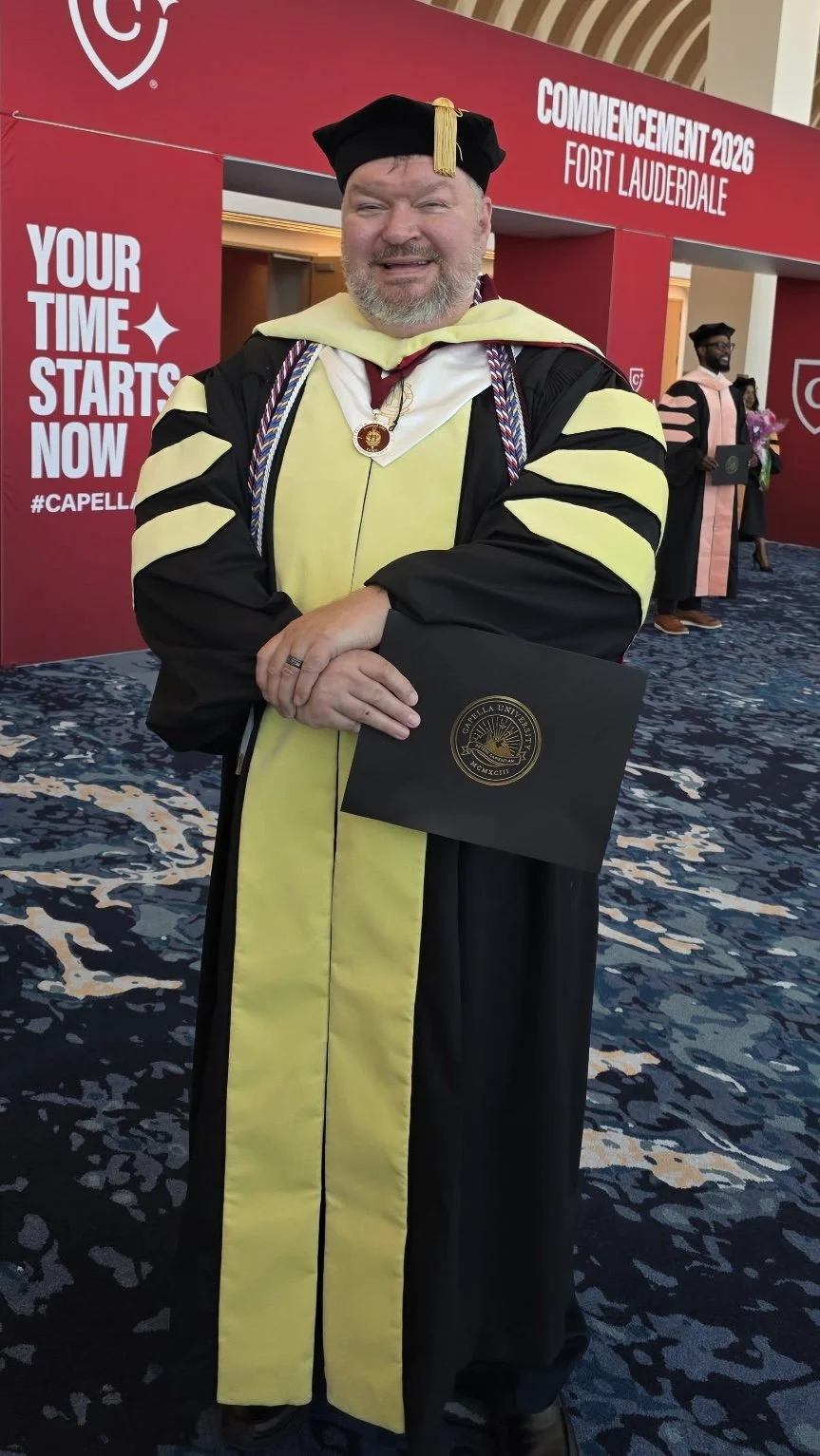
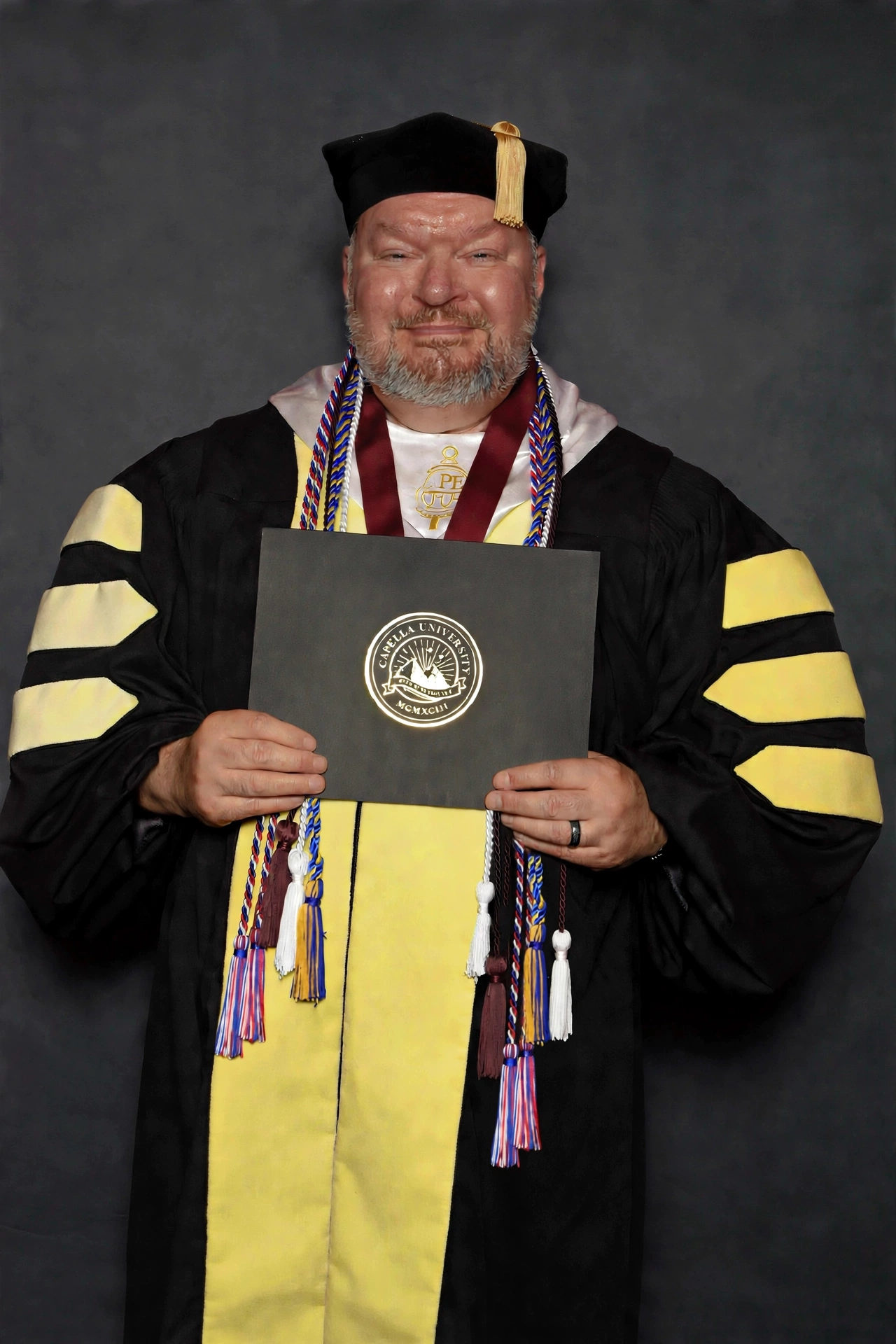
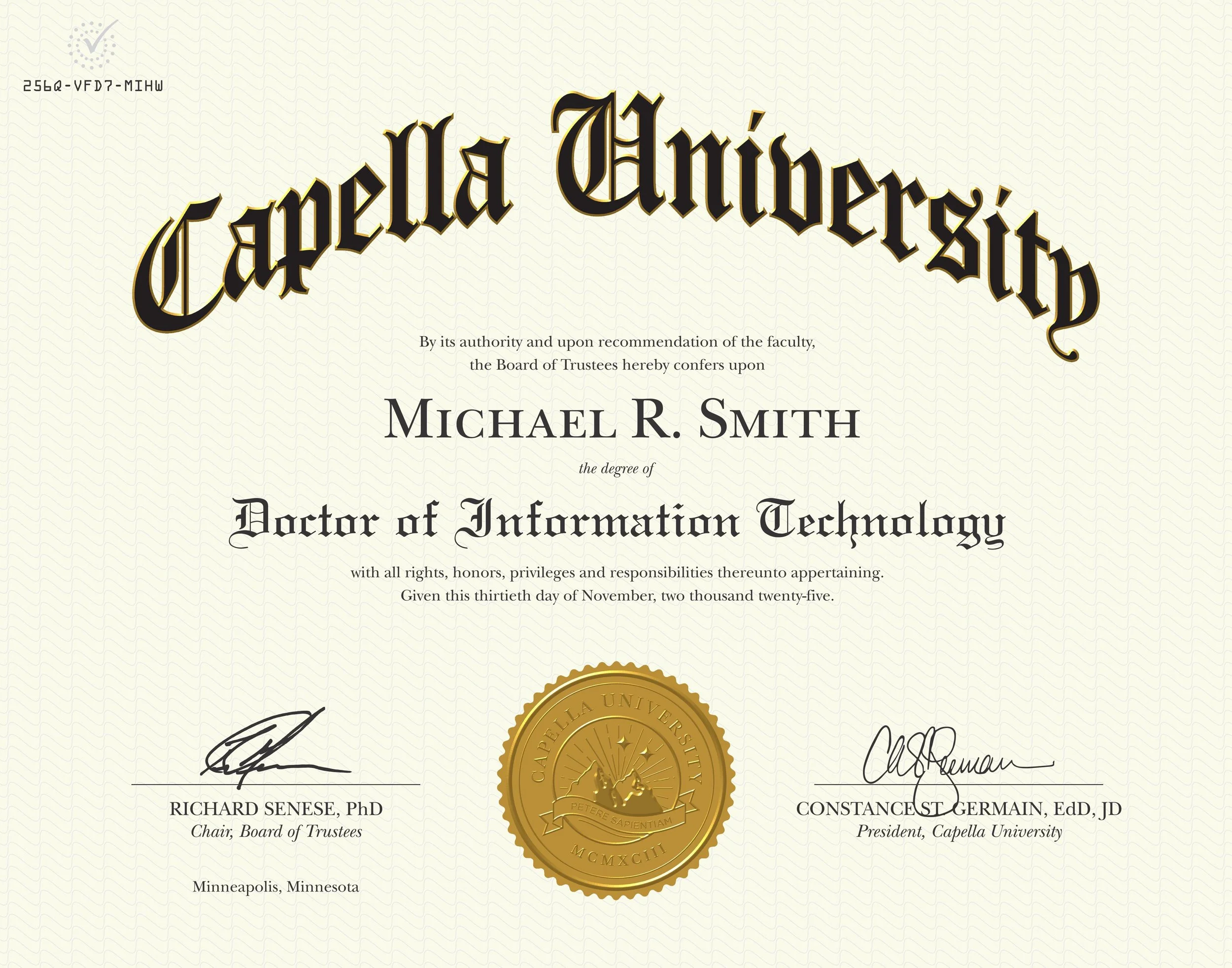
After spending about twelve years in the workforce, however, I began to see education very differently. By the time I returned to college, I had a much clearer sense of what I wanted from it and a greater appreciation for the opportunities it could create. Once I moved beyond the general education requirements and into subjects that genuinely interested me, I discovered that I truly enjoyed learning and the challenge of pushing myself academically. What began as a practical decision to return to school became something much more meaningful, ultimately leading me to complete a Doctor of Information Technology in 2025.

Doctor of Information Technology
After many years working in industry, I eventually reached a point where I wanted to deepen my understanding of cybersecurity and software development while remaining closely connected to the practical challenges I encountered in my career. Capella University’s Doctor of Information Technology program gave me that opportunity by allowing me to focus my studies on secure software engineering, cybersecurity management, and applied research.
For my capstone, I examined how software developers working in U.S. Department of Defense contractor environments adopt structured security testing within the waterfall development model. I was particularly interested in how security practices could be strengthened within environments shaped by strict contractual, regulatory, and compliance requirements. The program’s emphasis on connecting research with professional practice, reflected in its DIT curriculum, aligned closely with what I wanted from a professional doctorate.
Completing the degree in 2025 gave me more than an academic credential. It strengthened the way I analyze complex systems, evaluate research, and connect evidence-based findings to practical improvements in real-world technology and cybersecurity environments.

Master's Degree in Computer Science
Partway through my undergraduate studies, the university introduced a new degree program in Information Systems Security. By that point, however, I was far enough along in the computer science program that changing majors did not make practical sense, so I completed the bachelor’s degree as planned. When I continued into the university’s master’s program in computer science, I had much greater flexibility in selecting my coursework. I used that flexibility to take as many courses as possible from the Information Systems Security curriculum. As a result, although my master’s degree is formally in computer science, the substance of my graduate studies focused almost entirely on systems security and information assurance. During that period, I also became a member of the Golden Key International Honour Society, further reflecting the value I had come to place on academic achievement and continued learning.

Bachelor's Degree in Computer Science
I completed my undergraduate education at the University of Illinois at Springfield, graduating with a 4.0 GPA and earning membership in the Upsilon Pi Epsilon international honor society. The computer science program at UIS offered two primary areas of emphasis: one focused more heavily on software development and programming, while the other centered on systems security and information assurance. I chose the latter because it aligned closely with my growing interest in cybersecurity and the direction I wanted my career to take.
UIS is also designated as a National Center of Academic Excellence in Information Assurance Education. The National Security Agency and the Department of Homeland Security jointly sponsor the National Centers of Academic Excellence in Cybersecurity (NCAE-C) Program, which is intended to strengthen the nation’s cybersecurity workforce and reduce vulnerabilities in critical information infrastructure through education and research. Studying in that environment gave me a strong academic foundation in cybersecurity and information assurance and reinforced my interest in continuing in the field.

Associate's Degree in Computer Science
I began my college education at John Wood Community College, where I established the academic foundation that would carry into the rest of my studies. I graduated with a 4.0 GPA and became a member of the Phi Theta Kappa honor society. My experience there helped reinforce the value I had come to place on education and gave me the confidence to continue pursuing increasingly advanced academic goals.







Live as if you were to die tomorrow. Learn as if you were to live forever.
-Mahatma Gandhi